

In Conversation
William Ellis

Whilst we tend to write about the music and the performers, there are others who make a significant contribution to the story of jazz. One of these is the greatly respected photographer William Ellis whose exceptional pictures of jazz musicians give us a lasting atmospheric image of time, place and people.
William was born in Liverpool in 1957 but is now based in Manchester, although his work is international. "Although at the time I didn’t know it was jazz, the music came into my life when I was very young listening to Frank Sinatra records my mother would play," says William. "The sounds, the mixture and layers of every instrument you could imagine - made me just stop, listen and wonder how anything could sound so great. Then the Beatles happened and I didn’t actually discover jazz until later – much later when I began listening to Miles Davis."
William started taking photographs when he was around seventeen. "In jazz I found the music that says so much to me - a compelling subject with many facets - the people, the instruments, environment, lifestyle and being on the road. I spent around 15 years building up an archive of images of many of the most influential players in jazz performing at major festivals and clubs in the UK – people like Miles Davis, Dizzy Gillespie, Herbie Hancock, John McLaughlin and many other great musicians."
"Gaining access to photograph Miles Davis was the catalyst as it enabled me to get accreditation to photograph pretty well everyone else in the jazz world after my pictures were published in the programme of his 1990 concert."

Miles Davis © William Ellis
William's jazz photographs have always been inspired by the music and the powerful visual heritage of the genre exemplified by photographers like Roy Decarava, the Williams - Claxton and Gottlieb, and Herman Leonard ("who has said of my work – 'beautiful images' ") and his friend and fellow Brit, Terry Cryer whose jazz photographs from the 1950's stand alone. All the usual suspects - great photographers like Bill Brandt, HCB, Weston, Man Ray, Karsh, Penn, Avedon, Duane Michals, Ralph Gibson and Lee Friedlander are amongst his influences.
"In 2002 I decided to make my first foray into the international arena in Havana," says William. "This was closely followed a few months later by Toronto, New York and Cape Town. I went to Havana with a couple of Leicas and a Nikon. I still use the Leicas back stage and now shoot with Canon and for portraits I often use a Hasselblad, although I did use the Leica for some portraits of Spencer Tunick."
The pictures went down well in the press office. William got a 'Personal Invitation Pass' and "... the wonderful madness had begun - I was soon in a taxi heading with a singer from New York and her Cuban husband to the UNEAC (centre and gallery of Cuban writers and artists) where there was an exhibition being hung. It was here that I showed my work to a guy from Cape Town who turned out to be CEO of the city's jazz festival. He invited me on the spot to exhibit at the festival a few months later with the great Jürgen Schadeberg. At the time, Cape Town Jazz Festival was under the umbrella of North Sea Jazz – one of the world's biggest festivals. While I was in Cape Town, I met the marketing people who saw the exhibition and a year later e-mailed me inviting me to be guest visual artist with a 40 picture show there in 2004. It was there that I photographed among others, James Brown, Alicia Keys, Macy Gray and Buddy Guy."
William quickly developed contacts worldwide and over the next few years expanded his archive, met and photographed many more jazz greats, and worked alongside photographers from Reuters and AP who were covering major jazz festivals and conferences.

Dizzy Gillespie © William Ellis
Over the next three to four years, William's work was being shown at major festivals and galleries in Amsterdam, Birmingham, Bremen, Brecon, Brighton, Cape Town, Edinburgh, Glasgow, The Hague, Havana, Hong Kong, Kansas City MO, Las Vegas, Leeds, Liverpool, London, Los Angeles, Manchester, New York, Orlando, Penang, Scarborough, Southport, Toronto, Utrecht and Wigan.
"I photographed at many of the legendary clubs in New York and Los Angeles," he recalls. "The Blue Note, Village Vanguard, Birdland, Iridium, Jazz Standard, Catalina, Vitello’s and of course Ronnie Scott’s in London. One of the most significant events for me was an invitation to present the inaugural international exhibition at the American Jazz Museum in Kansas City in 2005. This was an organisation charged with showing jazz as it is now at the same time as capturing the heritage of jazz imagery. The show was very successful and I was invited to return in 2008 to exhibit in a group show 'Jazz in Black and White: Bebop and Beyond."
It was also in 2008 that William was commissioned by the management of the Bridgewater Hall, Manchester's £42 million international venue, to produce a body of work documenting the wide range of musical genres presented there and an insight into the backstage area. "This proved a particularly rewarding project," he says. "It enabled me to apply my experience in a different context - working at sound checks and in the dressing rooms as well as when musicians were performing. I found that everyone had something in common with the jazz players – total dedication to their art."

Tony Bennett © William Ellis
In 2010, William completed a tour of the UK with 3 musicians, Andy Scott, Dave Hassell and Mexican percussionist Evaristo Aguilar. "We toured with music based on a CD recorded the previous March in Tampico Mexico which was inspired by spending 3 days at Las Pozas – a surreal sculpture garden set in the jungle of the Huestaca region of Mexico. The English eccentric, poet and patron of the arts, Edward James, who was involved with Salvador Dali, Renee Magritte and others, created the gardens. The photographs I took there were projected above the stage at the concerts and formed the basis of extensive improvised sections."
In 2013, William began to bring together his 'OneLP Project' in which a musician is portrayed with a favourite album. Each portrait is accompanied by a short interview that explores the album's meaning and value for the person concerned. Acker Bilk, for example is pictured with Louis Prima's Strictly Prima album and says: "I like Louis Prima - I had the pleasure of working with him in New York a few years ago on Ed Sullivan’s show. We got chatting and I enjoyed his company - I enjoyed his playing and his singing is excellent - good jazzer!'
Clark Tracey is pictured with the album Thelonius Monk : Monk's Music and says: "I think probably because it's a nostalgic thing for me. It was obviously being played from my earliest years. The album cover appealed in the way it would to a child - Monk sitting in the trolley. The musicians on the album, the feel, everything - as I've grown up and matured with music it's turned out to be one of the best albums - it still appeals to me.' Details of the 'OneLP Project' and a selection of pictures is here, and Chris Barber with his choice of the Brownie McGhee album Sings The Blues, is here.
In 2015, William had his picture of Bennie Maupin shortlisted as one of six finalists for this year's Jazz Journalists Association 'Jazz Photo Of The Year Award.'

Benny Maupin © William Ellis
William has developed ties with the jazz industry worldwide and has exhibited at the European Jazz Network conference in Glasgow and in Europe, where Jazzahead! in Bremen is the leading showcase event attracting musicians, promoters, specialist labels and jazz organisations from all over the world. To date, there have been many highlights in his career and amongst the artists featured in his portfolio and exhibitions you will find Herbie Hancock, Liza Minnelli, the Hallé Orchestra with Elbow, Buddy Guy, Lesley Garrett and Christie Moore A collection is on permanent display in the Charles Hallé Room at the Bridgewater Hall in Manchester - the main corporate entertaining room.
"Photographing the Hallé in rehearsal was an extraordinary experience," William recalls, "being as unobtrusive as possible working in front of around 70 musicians and a Knight of the realm - conductor Sir Mark Elder - is very challenging, but so exciting visually and the sound of the music is sublime."
William Ellis has established his position as a leading jazz photographer with little formal training but has over 30 years of experience. He has worked with three major companies in the professional photographic industry: Keith Johnson, Hasselblad and Broncolor where he has been employed in technical sales. "This gave me a very wide take on the business of photography and an insight into all sectors of the business. Fortunately each of the companies I was with recognised the value of seminars and master classes in developing photographers technically, artistically and commercially. I have been involved in organising and helping to market training events with many gifted photographers including Cornel Lucas, Charlie Waite, Patrick Lichfield and John Swannell. As you can imagine, I gained a great deal of knowledge in pretty well all aspects of photography despite not having formal qualifications."
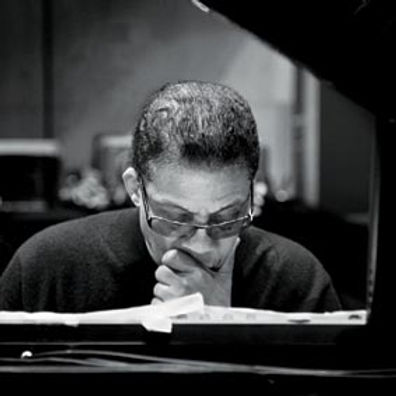
Herbie Hancock © William Ellis
Over the years William Ellis's photographs have been exhibited in many locations - they are currently exhibited at the Capstone Theatre Foyer in Liverpool from Tuesday 3rd Feb to – Sunday 15th April 2026 as part of the Liverpool International Jazz Festival (details here). If you are unable to visit the exhibition, do take a look at his website where you can read more about his story, see his photographs and, if you wish, buy copies of some of them.
You will find his website at www.william-ellis.com

© Sandy Brown Jazz 2026.3