

Sandy Brown Jazz
What's New
August 2026
If you are taking a beach holiday you might well not be thinking about jazz; you might prefer to build sandcastles, sleep on a lounger, get into the sea, read a book .... but just in case, Spotify have put together a playlist (here), and many seaside locations have jazz clubs nearby e.g. St Ives in Cornwall; Splash Point jazz clubs in Seaford and Eastbourne in East Sussex....... If you are going abroad, check out the website Jazz Clubs Worldwide. Whatever you do, we hope you have a good holiday.
Sharks Like Jazz?

The Club Of Mozambique website reports on a study of sharks with information attributed to the BBC. One finding states: "As far as Port Jackson sharks are concerned, it don’t mean a thing if it ain’t got that swing. Examples of the Australia-favouring, bottom-dwelling species were set a challenge: swim over to a certain spot of their tank when music played, and they’d be fed a reward. The study, carried out by researchers at Sydney’s Macquarie University, showed the sharks favoured the feeding spot when jazz was being played but were not able to make the same association for classical music. “It was obvious that the sharks knew that they had to do something when the classical music was played, but they couldn’t figure out that they had to go to a different location,” said researcher Culum Brown in a press release." There are more details here.
Jazz At The Proms
Predominantly a celebration of Classical music, this year's BBC Promenade Concerts include quite a selection of Jazz events.
On 8th August 'Round Midnight is a live edition of Radio 3's late-night jazz show at the Bristol Beacon's Lantern Hall. Guest-presented by Jamie Cullum, the night celebrates the John Coltrane centenary with a tribute from saxophonist Denys Baptiste, local trio Waldo's Gift, and Cassie Kinoshi's seed.
13th August has The Royal Albert Hall hosting the UK premiere of a BBC co-commissioned work by the celebrated jazz trumpeter and composer Wynton Marsalis.
On 20th August at the Royal Albert Hall there is a celebration of the Miles Davis Centenary featuring the American jazz trumpeter Ambrose Akinmusire, who will join the BBC Concert Orchestra and conductor Miho Hazama to perform Davis’s hits alongside classical influences like Gershwin and Rodrigo.
And on 6th September, Gwilym Simcock's Triple Concerto will be at the Royal Albert Hall , featuring the world premiere of the acclaimed jazz pianist's BBC co-commissioned piece for soprano saxophone, horn, and cello.
Three of these events will be recorded for future BBC broadcasts.

The Pocket - New York

A new jazz club in New York has been named 'The Pocket', the musical term meaning that a group of performers is perfectly in sync on stage. According to the Ultimate Jazz Glossary ""the pocket" (or playing "in the pocket") refers to a tight, highly synchronized rhythmic feel where musicians lock securely into a steady groove. It means playing with precise, effortless time - often sitting right on the beat or subtly behind it to create a relaxed, natural pulse." The new club, situated in the Muse hotel, a boutique hotel in the city’s Midtown area, is designed as a modern homage to the intimate jazz clubs of 52nd Street in the 1940s and 1950s, equipped with a state-of-the-art Fulcrum sound system and a restored 1964 Steinway grand piano which anchors the stage. More details here and their website is here.
Mercury Prize 2026 - Jazz Nominee
At the end of July the nominations were announced for this year's Mercury Prize - the award celebrating the 12 'Albums of the Year', recognising artistic achievement across an eclectic range of contemporary music genres. For some years now a Jazz album has been included in the nominees and this year that album is A Great Day In Newcastle by the band Knats. The album was released in May 2026. "Through a storytelling approach with the aid of new member, genius poet, Cooper Robson, the record details dark topics like substance abuse, crime and toxic masculinity through this Geordie Jazz Noir soundscape, whilst still feeling light hearted and playful, fully embodying the classic Northern optimism." You can read more about it and listen to the tracks here. The winner will be announced on the 22nd October and you read about the other nominees here.

Help For Live Music Venues
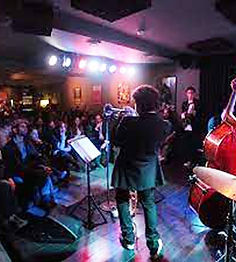
In July the UK government announced that pubs, clubs and live music venues in England will receive a 20% cut to their business rates bills saving the typical pub an estimated £1,100 next year (report here). In recognition of the pressures pubs and live music venues have been under in recent years, a 15% relief off their 2026/27 bill was announced in January, with bills frozen in real terms for a further two years. The additional 20% cut for pubs, clubs and live music venues from 2027/28 comes on top of this existing support. To target support where it is most needed, the government will not be making the new 20% discount available to the very largest live music venues. Details will be given in the Budget (probably late October or November), for example, will hotels that feature live music be included?
Video Juke Box

Click on the pictures to watch the videos..... or take pot luck and click on the picture of the Juke Box and see what comes up.
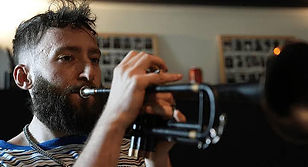
Dylan Jones previews his new album Statue. The album is the trumpeter's first as leader although he is known from his work with Tomorrow's Warriors and Ezra Collective. [See Recent Releases]
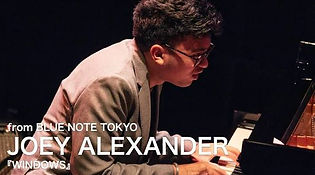
Young pianist Joey Alexander plays Windows from a gig in 2025. Joey has a captivating new album out Celestial Keeper with many jazz Standards. It is well worth hearing. Tracks are on YouTube or here in our Recent Releases page.
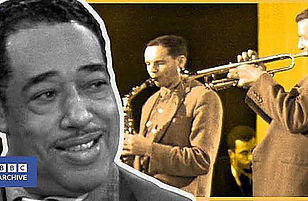
In this video, John Dankworth and Humphrey Lyttelton meet and interview Duke Ellington for a 1958 BBC Monitor programme. The video is interrupted twice for adverts but is still historically interesting.
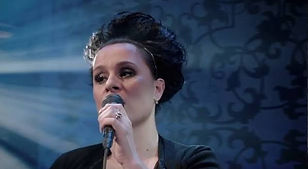
We have featured Dutch vocalist Trijntje Oosterhuis before, but although this video carries her name, we share it for the guitar playing of Leonardo Amuedo. You might like to compare it with the song played by Pat Metheny here.

This video of the Avon Cities Jazz Band playing Tishomingo Blues was filmed back in the 1970s between the Old Duke and the Llandoger Trow in King Street, Bristol. Geoff Nichols (trumpet); Chris Pope (drums); and ? Mike Hitchins (trombone); Ray Bush (clarinet); Dave Collett (piano); Clive Morton (bass guitar); Frank Feeney (guitar)

Pianist Nduduzo Makhathini plays Unembeza from his new Blue Note album The Myth We Choose [See Recent Releases}
Jazz Played Here
Jazz Club Ferrara
Italy
by Peter Maguire*
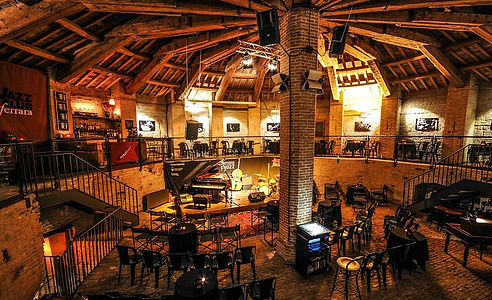
Ferrara is a city in the Emilia-Romagna region of Northern Italy. It is situated 44 kilometres (27 miles) northeast of Bologna, on the Po di Volano, a branch channel of the main stream of the Po River.
The Ferrara Jazz Club, formerly the “Circolo amici del jazz”, began its activities in the late 1970s. Since then it has given life to rich and prestigious events animated by illustrious names in the history of international jazz such as Miles Davis, Ornette Coleman, Michel Petrucciani, McCoy Tyner, George Benson, Wynton Marsalis and many others.
Since 1999, the Ferrara Jazz Club has operated in the prestigious Torrione San Giovanni, a splendid Renaissance bastion (1493) and jewel of the ancient Este walls protected by UNESCO. Within this space – thanks to the contribution of the MIC Ministry of Culture, the Emilia-Romagna Region, the Municipality of Ferrara and Endas Emilia-Romagna – Ferrara in Jazz takes place with a concert series consisting of over eighty concerts from October to April.

The Club can be found at Rampari di Belfiore, 167, 44121 Ferrara FE, Italië. Tel: +39 331 432 3840
and its website is here.
Here is a video from a year ago at the club :
*Trombonist Peter Maguire is based in Belgium and is the creator of the Jazz Clubs Worldwide website, a valuable database if you are looking for jazz clubs elsewhere. Peter will be telling us of other clubs in future issues.
Did You Know?
Lady Madonna

Paul McCartney's composition Lady Madonna owes much to the 1956 Humphrey Lyttelton hit recording of Bad Penny Blues. Both Paul and Humph acknowledge the riff on the record, played by pianist Johnny Parker on the original, as being a key element.
It is reported that Ringo Starr, who played snare drum to Paul McCartney's piano riff, "recalled that when recording the track the Beatles consulted (George) Martin on how to recreate the sound that Lyttelton had achieved on "Bad Penny Blues".
Both recordings have historical significance. Bad Penny Blues was the first British jazz record to get into the Top Twenty charts, and stayed there for six weeks. Its success was attributed to Johnny Parker's catchy boogie piano riff. The producer of the recording was Denis Preston who employed a young Joe Meek as recording engineer. Joe Meek is now considered one of the most influential sound engineers of all time for his studio work, mainly with pop/rock records.
George Martin, was head A&R man of Parlophone at that time. He was not involved in the recording of Bad Penny Blues (issued on the Parlophone label), but he became record producer, arranger, composer, conductor, and musician commonly referred to as the "fifth Beatle" due to his extensive involvement in each of The Beatles' original albums.
Here is the recording of Bad Penny Blues and here the recording of Lady Madonna.
.... and what did Humphrey Lyttelton think?
Two Ears, Three Eyes
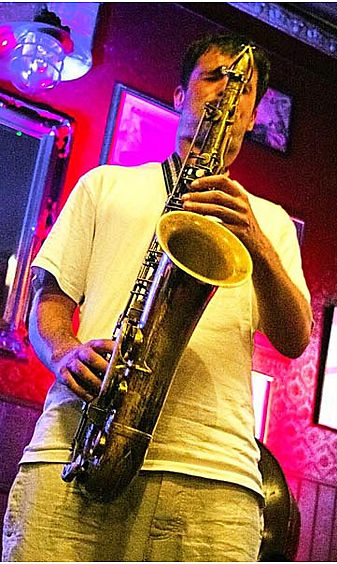
Brian O'Connor LRPS from Images of Jazz took this picture of saxophonist Gideon Tazelaar at the Speakeasy Jazz Club, Wick Inn, in Hove, East Sussex on the 22nd of July 2026. June. With Gideon were Mark Edwards (keyboard), Arnie Somogyi (bass) , Chris Coull (trumpet) and Andy Panayi (sax)
Brian says: "This was a good old fashioned enjoyable jam session -all that was missing from the 'old fashioned' was the smoke from cigarettes! Saxophonist Andy Panayi stood in for Gideon in the first short set as Gideon was delayed by an aircraft problem, but he was there for a second long set, and Andy continued to join in. A great duo, swinging jazz, and a wonderful atmosphere in a packed room."
Tenor saxophonist Gideon Tazelaar was born in the Netherlands but is currently based in New York - his website is here.
Here is a video of Gideon playing You Turned The Tables On Me with the Oscar Ployart Trio last December.
Insight
A series in which musicians give us insight into the background of one of their recordings
Randy Ingram
Sound Within :
A Celebration Of Bill Evans
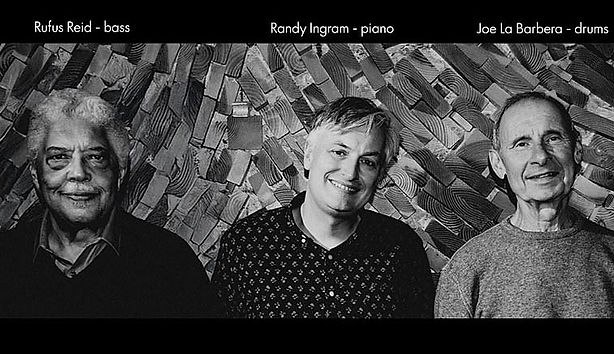
Pianist Randy Ingram was born in Anchorage, Alaska. His parents relocated to the warmer climate of Southern California when he was three, settling in Laguna Beach, California, a small town with an outsized appreciation for art and music. A piano student since the age of four, Ingram’s passion for jazz blossomed in high school, when he formed a trio with two musician friends that have gone on to earn Grammy nominations: bassist/producer Billy Mohler (Herbie Hancock/Dolly Parton), and drummer Nate Wood (Kneebody/Donny McCaslin). Randy earned scholarships to the University of Southern California, where he received his Bachelor’s degree in Jazz Performance, and The New England Conservatory (NEC), where he received his Master’s of Music.
While a project that celebrates Bill Evans’ profound influence has been a longtime goal of Randy Ingram, he was determined to wait until the right moment in his career to create a heartfelt homage that resonates in meaningful and personal ways. “The thing that’s most important to me about Bill Evans is not a style,” Ingram says. “It's not the way that he plays, or the devices that he uses. It's the sound of the piano, and that's something that comes from deep inside. So I made sure to hone in on my own sound for this album.”
Sound Within opens with the Evans classic “Turn Out the Stars,” Ingram setting the contemplative tone for the album with a short solo introduction before La Barbera and Reid enter with a tender yet vigorous rhythm in 5/4, placing the oft-reprised tune on a subtly challenging footing. It’s followed by the timeless “My Foolish Heart,” its lovely melody complicated by an unexpectedly tumultuous groove. The song, and Evans’s memorable take on it, was one of the pillars of the album in Ingram’s view. “That has been a very important song for me for a long time,” he explains. “I remember driving home from high school, when I probably should have been blasting Pearl Jam. But I had Waltz for Debby in the car stereo and would just sit there pressing repeat on the CD to hear ‘My Foolish Heart’ again because it was just so beautiful.”
“There’s an introspective thread that extends from Bill Evans through a lot of the music that I love,” Ingram says. “He was never faking anything on an emotional level; he was always able to speak who he was with total honesty. The way that I connect to Bill's music is through finding something undeniably true there. We live in an age where people seem to feel pressured to present themselves through curated external fronts, and I really appreciate someone like Bill who created something deeper, something that's real and that comes from more of an interior perspective.”
Randy has also embodied Bill Evans on screen. He portrayed the pianist in the 2013 Swedish film Waltz for Monica (aka Monica Z), a biopic of the singer and actress Monica Zetterlund that became the year’s highest grossing film in its home country and garnered several awards (trailer here). This original video (here) of Bill Evans with Monica Zetterlund and Some Other Time illustrates what Randy says about Bill Evans and "something that's real and that comes from more of an interior perspective.”
Randy Ingram’s three original compositions examine Bill Evans’s influence from a variety of different perspectives. The transportive “Aloft” is a free-floating marvel along the lines of “Very Early,” gliding on the pianist’s delicate touch. The title track, Sound Within, distills the central concept of the album into a resonant piece that follows Evans’s influence through the wide-open sounds of composers like Kenny Wheeler. “Remembrance” closes the set on an aching, elegiac note, mourning the loss of one of the music’s most towering figures.
Replace the missing letters
for the song title
Rehearsal
A series in which we catch on video musicians or a band in rehearsal.
Time For A Change
Purdue University Jazz Band
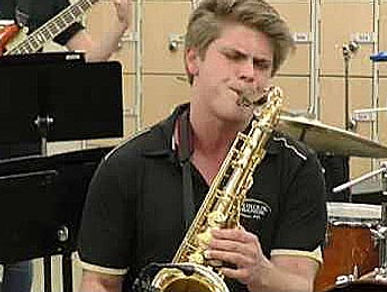
By its very nature, a rehearsal is not the finished product. It might not be perfect. It is a chance to make changes to the arrangement or to individual playing. Filming a rehearsal gives the band leader and the musicians the opportunity to reflect and see/hear how things sound. With Jazz, there is another element in that improvisation is not the same from performance to performance. What you hear in rehearsal might sound different another time, so to catch an improvisation is a 'one-off'.
Purdue University in Indiana is a well-established research university for engineering and technology. It also has a number of bands, including a talented jazz big band. Here they are rehearsing the Stan Kenton tune Time For A Change for a performance in 2018. Sadly, the name of the solo sax player is not given, but read the comments that go with the YouTube video about the time signature, the rhythm section, etc. As someone writes: "Looks like engineers make excellent jazz players".
The Story Is Told
Hector The Barber

'In 1963, before the Beatles burst on the scene, a brief but powerful infatuation with folk music gripped America. The TV show that came along at the right time to capitalize on the craze was Hootenanny ... At that time, Ronnie and Billy's grandfather lived with the Paquettes. He was known as Hector the Barber because that had been his trade ..... Hector the Barber rarely said anything. He just sat in the living room, tipping capfuls of bourbon whiskey into his coffee and smoking Tiparillos ... when he did talk, his discourse was peppered with profanity.
He liked Hootenanny though ... One night, after some white boy sang something about how his baby left him and he felt so sad, Hector the Barber snorted and said, "Shit, boys, that ain't the blues."
'
"What do you mean, Grampa?" Ronnie asked.
"Blues is mean music. That boy sounded like he just peed the bed and he's afraid his mama might find out." ......
"You wait," he said, and slowly mounted the stairs, yanking himself along by the bannister with one gnarled hand. He was gone so long the boys had almost forgotten about him when Hector came back down carrying a beat-up Silvertone guitar by the neck. Its body was scuffed and held together with a hank of frayed hayrope .... He sat down with a grunt and a fart, and hauled the guitar onto his bony knees ... "Shut that shit off," he said.
Ronnie did so ... " didn't know you played, Grampa," he said.
"Ain't in years," Hector said. "Put it away when the arthritis started to bite. I don't know if I can even tune the bitch anymore."
'"Language, Dad," Mrs Paquette called from the kitchen.
Hector the Barber paid no attention to her .... He tuned the guitar slowly, muttering curses under his breath, then he played a chord that actually sounded a bit like music.
"Wow!" Ronnie said. "Which chord is that, Grampa?"
"E. All this shit starts with E." .... he began to strum the old guitar, using one horney nicotine-yellowed fingernail as a pick ..... then he picked up a steady, chugging rhythm that made the boys glance at each other in amazement. His fingers slid up and down the fretboard clumsily at first, then ... a little more smoothly: B to A to G and back home to E .... In a high, wailing voice utterly unlike the one he spoke in (when he did speak), Ronnie's grandpa sang: "Why don't you drop down, darlin', let your daddy see ... you got somethin', darlin, keep on worryin' me ..."
.Hector the Barber was now thumping his foot in time and grinning. Con said he had never seen the old man grin before ........
"My mama don't allow me to fool around all night long ... she afraid some woman might ... might ..." He drew it out. "Miight not treat me right!" Hector launched into the second verse .... but then a string broke: TWANNG.
"Oh, you dirty c**t", he said, and that was it for Hector the Barber's impromptu concert. Mrs Paquette snatched away his guitar (the broken string flying dangerously close to her eye) and told him to go outside and sit on the porch if he was going to talk that way. Hector the Barber did not go out on the porch, but he did lapse back into his accustomed silence. The boys never heard him sing and play again. He died the following summer ....
An extract from Stephen King's novel Revival

Tea Break

A series where musicians and others stop by for an imaginary Tea Break to talk about their music and projects.
Brian O'Connor

It was towards the end of the afternoon when I arrived at Café Le Rêve to meet with photographer Brian O’Connor. Brian had been taking photographs at a gig in East Grinstead the evening before.
The café was quiet. Ferdinand, the owner was at his laptop ordering something tasty. Natalie, the French waitress was sitting listening to Joe the chef who was clearly trying to explain something with not much success. I joined them.
“What’s up, Joe?”
“Oh nothing really important.”
“Joe did a gig yesterday,” said Natalie. “A duet with a pianist and with Joe on keyboards. It didn’t quite work out.”
“We were just trying to work out why it felt off,” Joe said. “I guess I wasn’t quite sure of my part. The piano was dominant and I was trying to use the keyboard to complement and develop what he was playing. It was OK, I think, but I didn’t really get the chance to open out and that was quite frustrating. It was what it was.”
“It must be tough as a duet,” I added. “There is no room to spread the music out as there would be with other instruments."
“I think your interview has arrived, Ian,” Natalie said, getting up and greeting Brian O’Connor. His camera bag slung over his shoulder gave the game away.
I joined them at my usual reserved booth at the back of the cafe and introduced Brian to Natalie.
Hi Brian, let me get you a tea or coffee – what do you fancy?
Hi Ian, I’ll take a coffee please. The usual, black, no sugar, and strong. Really need the caffeine. Any chance of a doughnut?
Ah! So you have heard about the café’s speciality doughnuts then. Natalie, please could you ask Joe to prepare a few of his new lemon creams with sides and we’ll see if Brian approves. How did that gig at East Grinstead Jazz Club with Charlotte Glasson go, Brian?
It went very well. I've seen and heard Charlotte several times, usually as a group member. This was the first time as leader of the 'house' band. Vince Dunn on drums, Paul Whitten on bass, and standing in for Adrian York, Harry Bolt on keyboard. A very pleasant surprise, good with the audience, amusing anecdotes, and excellent multi instrument playing of the standards. I can’t even play the spoons, and she is more than competent on the sax, violin, flute and even the saw. Interesting version of Caravan on the saw.
Have you got one of the pictures you took?
Yes, there's this one, perhaps, with Charlotte on flute:
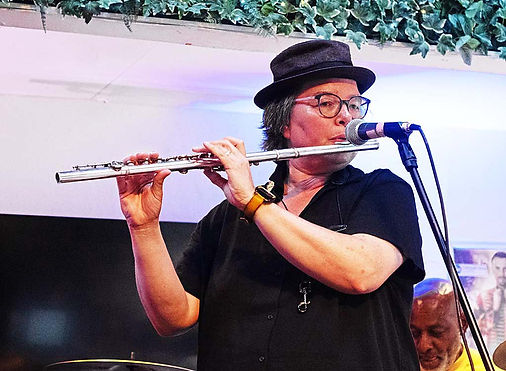
Charlotte Glasson
image courtesy of Brian O'Connor
That’s nice. I was thinking, you must have taken hundreds, if not thousands, of pictures of jazz musicians over the years. How did it all start? How did you become interested in photography? What was your first camera – can you remember?
I was always interested in cameras, and yes, I started off with a Box Brownie. Didn’t have the money to pursue it in any depth until I started work. My first decent camera was a used Ilford Sportsman at £6. More than a week’s pay. That taught me a lot as it was completely manual. Coffee’s delicious by the way. Any luck with the doughnut?
The doughnuts take a few minutes to prepare. They are all made fresh and I doubt if you will have tasted anything quite like them.
I can’t wait! Anyway, I then spent two week’s wages on a Weston Master lightmeter. Next I chose to take holiday photos etc. on slide film. Very little latitude in getting the correct exposure, so in order not to waste too much money it taught me all about getting the correct exposure, and the relationship between shutter speeds and apertures.
You even have letters after your name! LRPS – that’s a Licentiate of the Royal Photographic Society. I understand that to receive the award you had to submit 10 images that demonstrate a high standard of technical competence, visual awareness, and cohesive overall presentation to a panel from the Royal Photographic Society – can you remember what any of the pictures were?
Yes, it’s the first of three qualifications offered by the Royal Photographic Society, the top being ‘Fellow’. Although I submitted all jazz photographs, there had to be variations in angles, settings, lighting etc. I think two of my submissions were Dexter Gordon and Miles Davis. Quite chuffed to get the award and perhaps I should have tried to progress to the next level, but for many reasons I didn’t. One slight surprise and I’m not sure I should mention it, but amazingly it appeared to me that the panel tended to be swayed slightly by not just the quality of the image, but whether or not they liked the subject. Despite that I still succeeded with jazz images! Ah, the doughnut has arrived. Wow! Is that a doughnut! What do I do with it?

It is Joe’s latest creation. It is filled with lemon curd but there are other ingredients that take the sharpness of the lemon away and enhance the flavour. It comes with Joe’s special sauce – again secret ingredients that do the same with the filling. You pour some of the sauce into a bowl, dip the doughnut and sprinkle more sugar on if you want to ....... You told me once how you got into taking jazz photographs through your meeting reporter Stan Britt?
Ah, Stan! Sinatra has always been a favourite of mine so in the late ‘60s I joined the Sinatra Music Appreciation Society and met co-founder Stan Britt. We struck up a friendship that lasted a lifetime. He had a never ending knowledge of jazz and wrote extensively about it. By this time I had a reasonable reflex camera and soon began to go with Stan on many of his interviews and to gigs. This enabled me to meet many of artists who were quickly becoming my heroes and I was dragged, willingly, into the world of jazz.
I also remember you telling me about meeting and picturing Count Basie – remind me about that.
Yes, that was amazing. You never think that stars are in many ways just normal people with so-called normal lives. Who’d have thought Queen Elizabeth still used Tupperware? Stan was interviewing the Count in his hotel room. There he was, surrounded by some of his team calmly eating a large breakfast. I forget if it was a Full English, I was in awe at just being in his presence. The Count was vague on names, and one of Stan’s many gifts was that he could supply this information. The two were soon deeply involved in a conversation about jazz. Just one of many great memories.
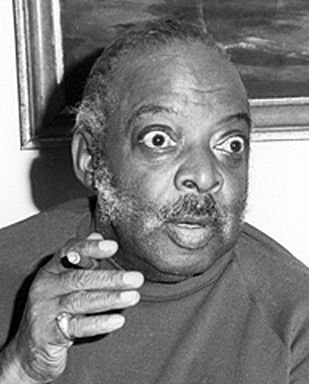
Count Basie
image courtesy of Brian O'Connor
One thing about your photographs is that they must remind you of the circumstances when some of them were taken. Do you have a favourite picture with a memory attached?
Let me just give the grey cells a stir. Maybe a bite of this doughnut will help. It’s worked! Oscar Peterson at Ronnie Scott’s. Stan, Oscar, and myself were in one of the miniscule changing rooms at the back of the stage. Oscar was a large man and we only just fitted in. He gave an amazing interview and didn’t mind at all that I was taking photos practically sitting on his lap. Lovely man.
Is there someone you always wished you could have photographed?
Time Out Ten
Softly, As In A Morning Sunrise
The MJQ

For this item you need to be able to stop for ten minutes.
We are often moving on to the next job, the next meeting, scrolling down social media, taking the next call ......'Time Out Ten' asks you to stop for ten minutes and listen to a particular piece of music; to find a time when you won't be interrupted, when you can put in/on your headphones and chill out. Ten minutes isn't long.
We heard from Milt Jackson last month in our ten minutes 'You time' and this month he plays for us again, this time with the Modern Jazz Quartet. I remember when I bought this LP, and when I took it home, my father couldn't understand why I liked 'that music'. I listen to it now and find it hard to see why he found it so terrible. Writing in All That Jazz, Rob Mariani says: "... What these four gentlemen brought to jazz and the world of music, out of the careening bebop fury of the early '50s was the sound of elegance. ..... That evening at The Tonight Show, they played "Softly as in a Morning Sunrise" and "I'll Remember April." It was a life-changing moment for me. This was a whole other way to think about music, I realized gradually. It was like discovering a colour I'd never even seen before....."
The origin of the song goes back even further than the '50s. The song comes from the 1928 operetta The New Moon with music by Sigmund Romberg with lyrics by Oscar Hammerstein II. Since then, it has been recorded by many jazz musicians, including Deirdre Cartwright's ORGANIK in their new album released in July (here).
But here is the MJQ from the 1950s. Take those ten minutes time out for yourself and relax ....
Tracks Unwrapped
Daahoud
by Clifford Brown
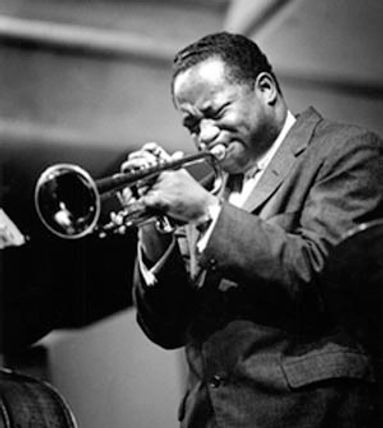
Trumpeter Clifford Brown was born on 30th October 1930 in Wilmington, Delaware. He was one of four boys whose father, also a trumpeter, organised his sons as a vocal quartet. Clifford was fascinated by his father's trumpet and started having trumpet lessons at school when he was about ten. At thirteen, his father bought him his own trumpet; he began taking private lessons and at junior high school he joined a jazz group arranged by a teacher. Clifford went on to Delaware State University to read Maths but soon transferred to Maryland State College with its musical strand and he went frequently to Philadelphia for the music there. By now he was playing in the fourteen strong, jazz-oriented Maryland State Band.
In June 1950 after a gig, Clifford was seriously injured in a car accident. He was hospitalised for a year and afterwards he was limited to playing the piano for some months. For the rest of his short life he continued to suffer with his shoulder dislocating. Nevertheless, during his stay in hospital he was visited by Dizzy Gillespie who encouraged him to continue with his playing and eventually Clifford started to play professionally. He quickly became a respected jazz musician.
Clifford's interest in the music had been stimulated by meeting Fats Navarro when he was just fifteen. He shared 'Navarro's virtuosic technique and brilliance of invention. His sound was warm and round, and notably consistent across the full range of the instrument. He could articulate every note, even at very fast tempos which seemed to present no difficulty to him; this served to enhance the impression of his speed of execution. His sense of harmony was highly developed, enabling him to deliver bold statements through complex harmonic progressions (chord changes), and embodying the linear, "algebraic" terms of bebop harmony. In addition to his up-tempo prowess, he could express himself deeply in a ballad performance' (Wikipedia).
'Brownie' as he became known, recorded and performed with Tadd Dameron, J.J. Johnson, Lionel Hampton, and Art Blakey amongst others. He formed his own band with drummer Max Roach and their Quintet became established as one of the leading 'hard bop' groups, writing and playing their own music. When saxophinist Harold Land left the group, he was replaced by Sonny Rollins and the band shone ever brighter. Clifford did not 'do drugs or alcohol' and Sonny Rollins has said: "Clifford was a profound influence on my personal life. He showed me that it was possible to live a good, clean life and still be a good jazz musician."
Daahoud was written by Clifford when he was just 23 years old. It was first released on an album by the Clifford Brown Ensemble 1955 album featuring saxophonist Zoot Sims and then on the Clifford Brown and Max Roach album in the same year. Here is that recording:
With regard to the origin of the name, 'Daahoud', Idris Dawud, says: "He (Clifford Brown) named the tune after Talib Dawud, my father. Dawud is the Arabic equivalent of 'David', meaning "my beloved". They were trumpet-playing acquaintances in Philly in the early '50s, along with Diz and Lee". In a later comment, Idris says: "To go a little further, there was the more well-known side of jazz musicians who used drugs, but there was also a very straight laced, spiritual crop of guys too, but you'll never hear about that. A lot of these guys studied and some adopted Middle Eastern religions, including Diz and Art. Coltrane was studying too, and it influenced his later music a lot".
However, Idris later accepts a different explanation from a jazz historian who links Daahood to pianist Roosevelt Wardell: "Roosevelt 'Daahoud' Wardell - "Spirituality and music are often said to go hand in hand, but rarely are they merged as clearly as in the essence of pianist Roosevelt Wardell. The descendent of a long line of clergymen dating back to pre-slavery Egypt, Mr. Wardell is perhaps best known by his family's spiritual name, Daahoud and as the subject of trumpeter Clifford Brown's famous composition by the same name. ......."
The Jazz Quiz
Jazzing All Over The World

For our quiz this month we challenge you to work out in which country 15 jazz musicians were born. We give you 2 options for each musician named, but can you choose their correct country?
The August Jazz Quiz is
Forum
The Bad Penny Blues
John Wellard writes, "Bad Penny Blues was the first record I ever bought I played it and played it and even though it was a 78, it survived. I loved blues and boogie piano. My cousin Chris Wellard - who was my hero as a kid, introduced me to the music and I spent many hours of time in his record shop in New Cross, South East London. Many years later I was fortunate enough to see Johnny Parker playing at a lunchtime session at Ketner's Restaurant - now renamed Pizza Express - and with luck got a table right next to the piano. I asked him could he do me the honour of playing "Stream Line Train" to which he kindly obliged. I went back the following day and gave him my beloved 78 of "Bad Penny Blues". He was quite frail by then and walking with sticks but I was proud to have met him. Even at the age of 82 I remember the occasion clearly."
Click on the picture to the right for the original recording of Humphrey Lyttelton's Bad Penny Blues with Humphrey Lyttelton (trumpet); Johnny Parker (piano); Stan Greig (drums); :
Departure Lounge
Information has arrived about the following musicians or people connected to jazz who have passed through the 'Departure Lounge' since our last update.
When this page first started, links to newspaper obituaries were free. Then increasingly advertisements were added and now many newspapers ask for a subscription to read a full obituary. Where possible, we initially link to a Wikipedia page which is still free of charge, but we also give links to newspaper obituaries in case you want to read them.
Plas Johnson
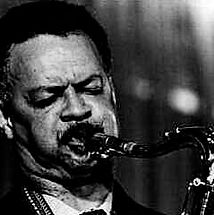
American saxophonist born in Louisiana in 1931. He is described as a "soul-jazz and hard bop saxophonist" and he worked as a session musician with many including Frank Sinatra and Peggy Lee. His obituaries mainly focus on his solo in Henry Mancini's Pink Panther Theme but not so much on his jazz playing. Plas passed through the Departure Lounge on the 15th July 2026. Obituaries: Wikipedia : The Guardian : New York Times : There is more of his Jazz work to explore on YouTube both in video and recordings - here he is playing Just One Of Those Things.
Recent Releases
A few words about recent releases / reviews:
Apart from where they are included in articles on this website, I don't have a 'Reviews' section for a number of reasons:
-
I receive so many requests to review recordings it is impossible to include them all.
-
Unlike some publications/blogs, Sandy Brown Jazz is not a funded website and it is not possible to pay reviewers.
-
Reviews tend to be personal opinions, something a reviewer likes might not suit you, or vice versa.
-
It is difficult to capture music in words, so much better to be able to listen and see whether the music interests you.
For these reasons in particular I just include a selection of recent recordings below where I share the notes issued by the musician(s) as an introduction and links to samples so you can 'taste' the music for yourselves. For those who like to read reviews, these, of course, can be checked out on other sites.
Some Recent Releases
You will find our Recent Releases page HERE where you can scroll down and see our featured releases. Included this month are:
UK
America
Randy Ingram - Sound Within : A Celebration Of Bill Evans
Joey Alexander - Celestial Keeper