

Sandy Brown Jazz
What's New
April 2026

Appropriately known by its initials, JAM , Jazz Appreciation Month was created by the National Museum of American History in 2001 to recognize and celebrate the heritage and history of jazz for the entire month of April. It culminates on the 30th April with International Jazz Day. The host city for this year's Jazz Day will be Chicago, but it will be recognised in the UK by a number of events, some you can find here. 100 years ago, in 1926, Miles Davis and John Coltrane were born, Jelly Roll Morton started recording with his Red Hot Peppers, Jean Goldkette's band with Bix Beiderbecke and Frankie Trumbauer started playing at the Roseland Ballroom in Manhattan, and Louis Armstrong released Heebie Jeebies with his Hot Five on the Okeh Label. There is much to celebrate.
London April Gypsy Jazz Festival
Set in the intimate, Paris-inspired Toulouse Lautrec Jazz Club in Kennington, the London Gypsy Jazz Festival 2026 brings together leading artists from Europe for four nights of joyful, high-energy acoustic music. Expect sounds rooted in Django Reinhardt’s pioneering style, blending melodicism, the atmosphere of 1930s Paris and the rhythmic drive of early American swing. The Festival runs from Thursday 16th to Sunday 19th April. Details are here.

Second Line In Savannah

This year, Savannah in Georgia hosts its Music Festival from March 26th to April 5th. The Festival opened with students from the Savannah Music Festival Jazz Academy leading a second line parade from Reynolds Square to he opening night show at Kehoe Iron Works. A video of the parade is here.
NYJO Education Hub
In March, the National Youth Jazz Orchestra opened a new Education Hub. The hub is a national online platform designed specifically to support musicians and teachers in delivering high-quality jazz and improvisation in classrooms, hubs and community settings. The resources have been developed and curated by NYJO’s learning team in collaboration with its emerging professional musicians - practitioners who are actively performing, composing and leading workshops across the country. The result is a bank of modular teaching resources, workshop plans, and materials which they hope will become the place to share best practice in delivering jazz education. "It is designed not just as a resource library, but as a sustainable professional development tool to help embed improvisation-led approaches across the sector and address the teacher confidence gap in jazz and improvisation." More details here.

Jazz and Art

Why are some artists inspired by jazz? Mikey Freeman in Kiarma, Australia talks about the graffiti, jazz and Shakespeare inspirations for his new exhibition 'Tempest' at Sevenmarks gallery. For graffiti culture: “Imagine young teenagers fixated on developing their own knowledge in colour theory, grasping the elements of design, though under cover of night. It existed outside permission, outside institutions. It was about reputation, repetition, and risk,” he said. For jazz: "It’s structured but open. I try not to be lured by too much decision-making when I’m creating, but feel, intuition. On one hand you’re working within a language, a visual language, but you’re also testing its limits in real time. Good improvisation in jazz is held within the key the song dictates, though within that lane the musician finds freedom through the dexterity that practice affords, not restriction.”
Video Juke Box

Click on the pictures to watch the videos..... or take pot luck and click on the picture of the Juke Box and see what comes up.

The Neil Cowley Trio has a new album out Built On Bach which is exactly that. The pianist describes it as "a collection of new compositions, all based loosely on the works of JS Bach, but styled and moulded to sound like the Neil Cowley Trio." Here is a video of Scurry from the album. [See Recent Releases]

Guitarist and bandleader Billy Marrows plays Shenandoah. His solo guitar version is on the album Penelope and a band version on the album Mount Tibidabo. Both are beautiful. Billy drops by for a Tea Break this month (here) and talks about his music and his new album Dancing On Bentwood Chairs.
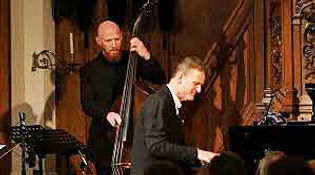
Clarinettist Alvin Roy has suggested we include this version of Caravan by Dutch pianist Peter Beets and his Trio. You can read more about Peter here. His recording Blues Goes To Spain was released in February (it does not include Caravan played in the video) [See Recent Releases]

The Bristol-based trio Yetii (Alex Veitch, piano, composition; Ashley John Long, bass and Alex Goodyear, drums play the beautiful Afar from their recent album Inner Worlds [See Recent Releases]

Here is Woody Herman and his Swingin' Herd back in 1964 with Woodchoppers Ball. Woody Herman was responsible for bringing so many key jazz musicians to notice - here, the first solo is taken by Sal Nistico and the trombone solo by Phil Wilson about whom one commentator says "He taught me how to doodle tongue using (the) Arbans (method). I am eternally grateful, as this was most important jazz technique I ever learned and to this day, I can immediately tell the difference between those who can doodle and those who don't."

Founded in 1945 in the Netherlands by reeds player Peter Schilperoort, the Dutch Swing College Band was prominent during the Trad Jazz 'boom' of the 1950s. Europe's longest established band is still going although Peter Schilperoort died in 1990. Here they are in 1970 with Bourbon Street Parade.

The impressive Louise Balkwell sings I Can't Give You Anything But Love from her uplifting new album Chatterbox [See Recent Releases]
Did You Know?
Easter Parade

Picture courtesy of BKMag which has more pictures and information about the Easter Parade
On the avenue
Fifth avenue
The photographers will snap us
And you'll find that you're in the rotogravure
Oh, I could write a sonnet
About your Easter bonnet
And of the girl I'm taking to the Easter parade
Easter Sunday in the UK is on the 5th April. Easter, also called Pasch or Pascha, it is a Christian festival commemorating the resurrection of Jesus. It is still celebrated as such around the world - for those of you in Australia it will be autumn, but apparently some of you will still celebrate the Christian story, and many will spend time with family, welcome the Easter Bunny, and have hot cross buns and Easter eggs.
There is an ancient tradition of wearing new clothes for Easter to signify "harmony with the renewal of the year and the promise of spiritual renewal and redemption." So daffodils, lambs and chicks appear in greetings. But the tradition of new clothes for Easter goes back a long way - Shakespeare's play Romeo and Juliet was published in 1597 and in it, Mercutio says of Benvolio: "Did'st thou not fall out with a Tailor for wearing his new Doublet before Easter?" And of course, part of the new clothes tradition is the Easter Bonnet, and it seems that in turn relates back to religious expectations for women to be wearing a head covering.
The Roman Emperor Constantine I, in the early part of the 4th century, "ordered his subjects to dress in their finest and parade in honour of Christ's resurrection". More recently however, starting as a spontaneous event in the 1870s, the New York Easter Parade has become increasingly popular - it's a festive walkabout that makes its way down Fifth Avenue from St. Patrick's Cathedral. Here is a video of a couple dancing to Drew Nugent and the Midnight Society Band playing Some Of These Days - interesting for the range of characters and styles of those dancing. Alternative dancing from Fred Astaire and Judy Garland comes from this clip from the movie Easter Parade.
Many jazz bands have recorded Irving Berlin's song Easter Parade - from Acker Bilk to Oscar Peterson to Ruby Braff and others; and here are Joel Frahn, Carla and Andrea Motis and the Sant Andreu Jazz Band with their version of the song:
Anagram
Rehearsal
A series in which we catch on video musicians or a band in rehearsal.
The Michigan All-State
Jazz Ensemble

Just because a band is in rehearsal it does not mean that the outcome cannot be appreciated. In our series this month we feature the Michigan School Band & Orchestra Association (MSBOA). The Association established its Jazz programme ten years ago in the 2005-6 school year. Five ensembles are selected from recorded auditions: a Middle School String Orchestra, a Middle School Band, a High School Full Orchestra, a High School Band and a High School Jazz Ensemble. An average of some 2,500 students audition each year for the 400 seats in the five ensembles.
In January the students assemble for two and a half days of rehearsal with nationally recognized conductors. A concert is held on the Saturday of the Michigan Music Conference. In this rehearsal, the guest condictor is Dr. Tracy Heavner from the University of South Alabama.
Tea Break

A series where musicians and others stop by for an imaginary Tea Break to talk about their music and projects.
Billy Marrows

Guitarist and bandleader Billy Marrows first got heavily into Jazz at the age of 15 after his cousin Jonas introduced him to Weather Report and musicians John Scofield, Allan Holdsworth and Steve Coleman, but before that he was already writing music, going on to attend a composition summer school aged 16 with educator Issie Barratt who encouraged him to write something for the National Youth Jazz Collective (NYJC). A form teacher at his Easingwold school in North Yorkshire was equally encouraging teaching him about jazz and even getting him his first gigs. Then Billy went to the NYJC summer school and perhaps it comes as no surprise that years later he has now been teaching there as well.
Billy graduated from the Royal Academy of Music in London with a first class degree in jazz guitar. During his time there he won the 2016 small ensemble prize of the Dankworth Prize for Jazz Composition and wrote a gamelan-inspired suite for the 2016 Lancaster Youth Jazz Commission. Following his graduation he studied with Vince Mendoza on the 2018 Metropole Orkest Arrangers’ Workshop in Holland; again won the Dankworth Prize for Jazz Composition - this time for the big band category, and in 2019 he won the Eddie Harvey Jazz Arranger of the Year Award.
Based in London since 2013, he leads the Billy Marrows Band and his project Grande Familia, as well as taking part in a wide range of other bands and recordings. His own debut album, Penelope, was recorded in 2023. It was named for his mother who was struggling with cancer and the album was released in January 2024 in her memory with proceeds of over £6,000 going to World Child Cancer. The album was shortlisted for Album Of The Year in the 2025 Parliamentary Jazz Awards. The recording established Billy’s Grande Familia project which performs in a number of different ensembles. An EP Mount Tibidabo was released by a sextet in November 2024 and was followed by a further album The Penelope Album Live in March 2025.
Now, in 2026, Billy releases a new album Dancing On Bentwood Chairs. He stopped by for a Tea Break to tell us about it and to look back on the past few breath-taking years.
Hi Billy, good to see you. I've managed to bag a booth in this cafe so we can chat, and I've spoken to Ferdinand, the manager, who will play some music from your album if we ask. What can I get you tea, coffee?
Hi Ian, good to see you too! Tea please.
Do you have sugar?
Just milk please, no sugar.
Ferdinand is bringing it over in a minute. So, how are things going with the album? I know you have been pretty busy with the PR.
The new album release has been going well thanks. As with the Penelope album, I did all the PR myself so it was wonderful to receive four lovely reviews in the week around the release. One of them was probably the kindest review I’ve ever received for any of my releases, so I was pleased that people were enjoying the album. It was fun to do a listening party on Bandcamp a few days after the release, there’s something special about listening together and sharing thoughts about the music. It’s always an intense experience releasing music, with a lot to do, including promoting the album launch. You only get one shot at the release, so there’s a feeling of not wanting to miss the chance to get it out there as much as you can. The album was recorded in December 2021, so it feels great to finally have it out in the world, and nice that people don’t seem to care that it was recorded so long ago. I’m happy that there’s been a great response to my dad Tim Morrison’s cover artwork.
It must have been quite different from the 2024 Grande Família 'Penelope' project. That was a wonderful tribute to your mum. There is a nice montage from the launch at the Vortex on YouTube where I particularly responded to Teresa's viola snippet.
Do you have a favourite track from the album?
I think my favourite is possibly ’Nights Are Drawing In’. It’s a setting to music of Robert Frost’s ’Stopping by Woods on a Snowy Evening’, but with the words removed as his estate wouldn’t let me use them. I like the atmosphere it creates, and particularly love how Dijan Mbanu (flute) and Anna Drysdale (French horn) play the melody, and Chris Williams’ hauntingly melodic alto sax solo (Chris is also on the new quartet album).
I agree. I think the title is appropriate to the atmosphere the three instruments create. For me, probably because I have always loved the tune, I think 'Shenandoah' is absolutely beautiful. You included it in the 'Mount Tibidabo' album as well, but why did you initially split it into two parts?
Ah, yes. On the Penelope album I played Shenandoah solo. I really wanted to include it on the record as my mum had been singing it around the time she first got ill, when her singing voice suddenly came back after losing it for a while after she had Covid in Dec 2020, but there was only time for one short take at the end of the session, and it’s a fairly improvised arrangement, so I was pleased it came out ok. I'd been intending to arrange it for the full Grande Família, but hadn’t had time, so when we did the album launch I arranged it for them, but played a short solo version to start off with, then Angus brings in the full band version (Part 2) when the audience think the song has finished. Before knowing that I was going to release the launch as ’The Penelope Album Live’ on Discus Music, I wanted to record a version of the ensemble version of Shenandoah, so created a sextet arrangement which we recorded for the Mount Tibidabo EP, hence ending up with the three versions of Shenandoah that I’ve released - solo, sextet and 12-piece live.
I guess I should ask why you call the various groups 'Grande Família'?
Interesting question. Well, I decided on that name shortly after booking the recording session for the Penelope album. It’s Portuguese for "big family”. The initial spark for the project was when me, my girlfriend Teresa, one of my cousins, Jonas, and one of his nieces, Dijan, played a couple of pieces for my mum. It was when her sister’s family were staying in the village where I grew up, to visit my mum over Easter weekend, about a month after her terminal cancer diagnosis. There was about 25 of us there in total, and it was the first time Teresa met any of my family! Teresa is Portuguese, and I had just started trying to learn the language, hence the Portuguese band name. Jonas, Dijan and Teresa are all in Grande Família, so the name reflects that, my big extended family, and the musical family that you get in a band or community of musicians and those who support the music.
It seems quite a 'family' of musicians, going back to that montage video, there seems to be an understanding between them. How did you bring them together, and was there that camaraderie?
It was after playing with Teresa, Jonas and Dijan for my family in April 2023 that I decided to make the Penelope charity album, and originally to be the four of us. I quite quickly decided to add some more of my favourite musicians/people to make a large ensemble. It was all organised quite quickly, with the recording set for 27th June 2023, so I was very fortunate to get such a wonderful line up. There was definitely a sense of camaraderie and it really felt like everyone came together to make it happen in the studio; we’d only had one rehearsal which none of the brass could attend, and had to get all the large ensemble pieces recorded by 2.30pm on the recording day … so I was very happy with how it worked out.
So now there's your Quartet with Chris Williams, sax; Huw V Williams, bass; and Jay Davis, drums; and a new album 'Dancing On Bentwood Chairs'. Initially I read that as 'Brentwood' chairs and expected a reference to a place in Essex, but it is actually a quote from artwork by your dad - what is that all about?
Haha yes! It has nothing to do with Essex, though the album was recorded on Essex Road in Leyton - I also know Brentwood pretty well as I play in a big band that does a project with Brentwood School Big Band every year. I’ll tell you how I arrived at the album name. When I was writing the title track towards the end of 2018 I was visiting my parents and noticed a line at the bottom of one of my dad’s artworks: “My days of dancing on bentwood chairs were over... until now!”. I asked him about this and he told me the story of when he was an art student in 1970's Edinburgh, he and his friends planned a flash-mob dance on bentwood chairs in a cafe … and that now, many years later he's back to creating the art he really wants to, without any commercial or fashionability concerns. I took the phrase for the track and album name, as well as being encouraged to do whatever I wanted to do musically.
The Story Is Told
Flash Dance
Doubles and More

Now I hear the music
Close my eyes I am rhythm
In a flash it takes hold
Of my heart
What a feeling (what a feeling)
Being's believing (being's believing)
I can have it all now I'm dancing for my life (so dance right through your life)
Take your passion (what a feeling)
And make it happen (being's believing)
Pictures come alive you could dance right through your life (so dance right through your life)
For some, Flashdance will be the 1983 movie starring Jennifer Beals where Alex, an 18-year-old female amateur dancer who dreams of joining the Pittburgh ballet school and performs nightly at a dancing bar, works as a welder during the day. It is the classic story of overcoming the odds to finally find success. Eventually, Alex's obtains an audition for the dance school before five stuffy judges. She puts on a recording of "Flashdance... What a Feeling," starts her dance, stops and starts again. During the slow beginning of the song, the judges seem completely unimpressed and maybe even bored, but when the tempo picks up the stodgy judges begin to loosen up ....... Spoiler alert 1: While Jennifer Beals performed some of the dances, the complex dance numbers were handled by multiple body doubles. Spoiler alert 2: We are not told whether she passed her audition (but we assume she did). The audition clip is here.
Put 'Flash Dance' into Google and the movie comes up. You have to scroll quite a way down to find 'Flash dancing'. 60 years before the movie, Flash Dance was a form of tap dancing (also called Jazz Dance at the time) that evolved in the 1920s–1930s, and which combined dance with acrobatics. Key exponents were the Nicholas Brothers - no 'doubles' here. Watch them in the 1943 movie Stormy Weather dancing with Cab Calloway's orchestra:
Self-taught dancers, Fayard and Harold Nicholas grew up in Philadelphia, the sons of musicians who played in their own band. At the age of three, Fayard would sit in the front row while his parents worked, and by the time he was ten, he had seen most of the great African-American vaudeville acts. In 1926 they gave their first performance at the Standard Theatre where their parents worked, then, in 1932, they became the featured act at Harlem's Cotton Club - Harold was 11 and Fayard was 18. "They astonished their mainly white audiences dancing to the jazz tempos of Bugle Call Rag; and they were the only entertainers in the African-American cast allowed to mingle with white patrons. They performed at the Cotton Club for two years, working with the orchestras of Lucky Millinder, Cab Calloway, Duke Ellington and Jimmie Lunceford.
Fast forward to 2003, and rather than doubles, the start of dancing by mobs - Flash Mobs. First created in Manhattan by Bill Wasik, senior editor of Harper's Magazine, he is quoted as saying: "the mobs started as a kind of playful social experiment meant to encourage spontaneity and big gatherings to temporarily take over commercial and public areas simply to show that they could". The first attempt was unsuccessful after the targeted retail store was tipped off about the plan for people to gather. But the idea grew and now amazing gatherings of dancers and others stage flash mobs in many countries. It is 7.30 in 2016 at Antwerp's Grand Central station and this happens! They are not just about dancing either. Here is a Jazz Flash mob (with dancers) in Warsaw in 2014.
Take your passion (what a feeling)
And make it happen (being's believing)
Take Two
Rhythm Is Our Business

Rhythm is our business, rhythm is what we sell
Rhythm is our business, business sure is swell
Now, if you blue, rhythm's what you need
If you got rhythm you're sure to succeed
Rhythm is our business, business sure is swell
Saxophonist and bandleader Jimmie Lunceford was born on a farm in Mississippi in 1902. The family then moved to Denver where Jimmie attended high school and studied music under Wilberforce J. Whiteman, father of Paul Whiteman. In 1927, Jimmie organised a student band, the Chickasaw Syncopators, whose name was changed to the Jimmie Lunceford Orchestra. Under the new name, the band started its professional career in 1929, and made its first recordings in 1930. After a period of touring, in 1934 the band accepted a booking at the the Cotton Club for their revue "Cotton Club Parade" starring Adelaide Hall.
Rhythm Is Our Business was composed by Jimmie, Sammy Cahn and Saul Chaplin and became one of the band's most popular numbers. The band was more know for its ensemble work, but this number introduced some members of the band who then took breaks. This is a notion that we find again in the film High Society (Now You Has Jazz) and, something we discuss in this month's Forum section. With Now You Has Jazz, the breaks are brief and are introduced and / or credited: "Now you has Mr Barrett Deems"; In Rhythm Is Our Business, the breaks again are short. and expectations are also set for how the soloist will play: "X plays the saxophone in the band. Oh, when he goes up that scale. (One line of scat singing followed by saxophone break)" and "He blows on the trumpet in the band. X blows on that trumpet in the band. Oh, he's the guy, hits `em high."
Here is Jimmie Lunceford's Orchestra with the number in 1936:
Jimmie Lunceford was just 45 years old when he died. On the 12th July, 1947, Jimmie and his orchestra were in Seaside, Oregon, to play at The Bungalow dance hall. Before the performance, Jimmie collapsed during an autograph session at a local record store. He had complained about an aching leg as they arrived in Seaside; he had been suffering with high blood pressure for a while, and had recently complained about not feeling well. He died while being taken by ambulance to the local hospital.
Over the years since then, Rhythm Is Our Business has gone on being performed by big and small bands. Here are Vince Giordano and the Nighthawks in 2016: (or you can taste a small band version here with the Tooscanians from Tuscany).
Jazz Played Here
Bluebird Jazz Bar, Bangkok
by Peter Maguire*

The Bluebird Jazz Bar is a small, intimate club on the third floor of a charming building at 355/3 Thong Lo, Khlong Tan Nuea, Watthana, Bangkok 10110, Thailand Tel: +66 89 777 9248. A favourite among jazz lovers it is a cozy alternative to the city’s larger nightlife spots and is frequently praised for its cozy and intimate feel, resembling someone's home rather than a typical bar. Many reviews highlight the warm atmosphere that enhances the overall experience. The music quality is among the best live jazz experiences in Bangkok, though the venue can get quite crowded on weekends due to its small size.
Musicians and guests often interact, creating a welcoming environment where everyone feels at home. The bar hosts jam sessions, inviting guests to participate and share their musical talents, making it a unique venue in Bangkok's nightlife scene. The Bar is usually open from Wednesday to Sunday each week from 5.00 pm to late, but check their Facebook page HERE for up to date details, gigs and videos that give you the idea of the venue and the atmosphere.
*Trombonist Peter Maguire is based in Belgium and is the creator of the Jazz Clubs Worldwide website, a valuable database if you are looking for jazz clubs elsewhere. Peter will be telling us of other clubs in future issues.
Aleph Aguira
Sugar On My Blackbeans
by Howard Lawes*

Aleph Aguiar is an international musician and composer, originally from Venezuela. He released his first album, Dialegs in 2011, just before moving to London in 2012. Since then he has released a variety of music including jazz/rock (Conectado), compositions for contemporary dance companies (Odyssey, Whitehall 9400 and These 4 Walls) and two albums of Afro-Venezuelan jazz, Pataruco (2015) and Maku (2017). Aleph’s upcoming album, entitled Sugar On My Blackbeans (2026), continues the jazz theme and via a Zoom call Aleph described his varied life in music and the influences that have shaped the new album. Listen to the title track:
Aleph Aguiar was born in Caracas in Venezuela but lived in San Felipe in the Yaracuy region. His mother was a contemporary dancer and his father a singer, so the home was always full of music. Aleph and his brothers learned to perform at an early age, Aleph learning the double bass, and it wasn’t long before he was playing in a band doing rock music covers. By the age of 13 he was playing with a professional band called 'Luango' whose mission was to preserve the music, history and culture of the region. Aleph also played with Simon Diaz, a hugely popular artist in Venezuela who worked to preserve the musical heritage of the country.
The traditional music and dance of the Yaracuy area is called 'Joropo Jorconiao', which Aleph describes as fast and exciting and very much associated with parties and celebration. Typically, the instruments used to create the music are the cuatro venezolano (a cross between guitar and banjo), the arpa llanera (large harp of the plains) and maracas (there is a video about Joropa here). Another style of Venezuelan music is the 'Merengue Caraqueno' which has spread throughout the Caribbean region and is notable for its 5/8 time signature. Despite being drawn to heavy rock bands such as Led Zeppelin and Metallica, Aleph still has great affection for Venezuelan traditional music with its origins in Africa and Spain, and as many composers know, those early influences stay with you forever. Other musical influences include recordings of Jimi Hendrix and Carlos Santana, such as at Woodstock in 1969, which Aleph has seen many times and the great latin-jazz trumpeter Arturo Sandoval, who maintained a special relationship with Venezuela.

Aleph Aguira Quintet
At the age of 19 Aleph moved to Barcelona in Spain but rather than complete an academic path at the Taller de Musics he much preferred perfoming with local bands in clubs and festivals. Despite choosing this vocational option he continued to study and work hard which he believes is essential for any musician. In Barcelona Aleph met and performed with the Brazilian bass player Munir Hossn who he much admires. Aleph began listening to, and transcribing the music of, great jazz guitarists such as Wes Montgomery, Pat Metheny and George Benson. In Spain, because of his heritage, he became interested in Basque culture but found the food more interesting than the music!
Aleph first visited London in 2005 as a member of a Spanish band and having decided to spend a few extra days, was very much impressed with the music and venues in the city. He went to jazz jams and met trumpeter, Quentin Collins and saxophonist, Brandon Allen at what is now the Blues Kitchen in Shoreditch. Although he returned to Spain for a while, Aleph decided to move to London permanently in 2012 and has established himself as part of the vibrant jazz and latin-american music scene in the city.
His first album project in London was called Pataruco (2015) which is a word in Venezuela that refers to a male chicken (rooster) that is unsuitable for cockfighting. This rather cruel activity would have attracted large crowds and a lot of gambling in Venezuela when Aleph lived there.
Maku (2017) features just Aleph on guitar and Michele Montoli on double bass, and the music includes some nice arrangements of jazz standards, Preludio a Un Beso (Prelude to a kiss) and Cuando Me Enamoro (When I Fall in Love). Since arriving in London Aleph has played in bands for West End shows, accompanied and composed for contemporary dance companies and has become a member of Georgia Cecile’s band.
Here is Cuando Me Enamoro (When I Fall in Love) from the Maku album:
*Saxophonist Howard Lawes is National Jazz advisor for U3A Jazz Groups and a freelance writer who contributes each month to Sandy Brown Jazz What's New magazine.
Time Out Ten
Karsten Vogel
Sweet Lorraine

For this item you need to be able to stop for ten minutes.
We are often moving on to the next job, the next meeting, scrolling down social media, taking the next call ......'Time Out Ten' asks you to stop for ten minutes and listen to a particular piece of music; to find a time when you won't be interrupted, when you can put in/on your headphones and chill out. Ten minutes isn't long.
Danish saxophonist saxophonist Karsten Vogel has released an album of Late Night Ballads that contains some ideal music for this month's ten minute time out with tunes we know and some lovely improvisation.
With a career spanning more than six decades, Karsten is one of the true veterans of Scandinavian music. British jazz critic Richard Williams once wrote in Melody Maker: “There aren’t many alto saxophonists to whom I’d rather be listening. He has a lovely tone – slender, fibrous and very human – and a shallow vibrato: a highly distinctive combination.” And yet Karsten's alto saxophone sound has been heard across rock, jazz, and jazz-related genres on more than 75 releases, and his career has taken him far beyond Denmark’s borders, with concerts across Europe, the USA, Japan, and India. He is widely known as a founding member of legendary jazz-rock bands Burnin Red Ivanhoe and Secret Oyster.
But here, with Mads Søndergaard (piano); Peter Hansen (bass) and Klaus Menzer (drums), his album of seven classic ballads from the American songbook and one original composition (Open 24 hrs), Karsten brings us music for relaxing - late night - or any time.
The album Late Night Ballads was released on the Storyville label in February. Listen to Sweet Lorraine in your ten minute time out:
Where Am I?

It’s April, and it’s Spring, and it’s charming. The chestnuts are in blossom and the tables under the trees give me a feeling that it would be hard for anyone to feel again. What have you done to my heart? I have never missed a warm embrace before or knew that my heart could sing like this.?
The answer is HERE
Two Ears, Three Eyes

Brian O'Connor LRPS from Images of Jazz took this picture of clarinettist Adrian Cox at The Watermill Jazz Club in Dorking at the end of February. Adrian always comes with an infectious humour and his playing is always enjoyed. On this occasion Brian O'Connor writes "An absolutely fabulous gig at the Watermill last night, old time jazz brought up to date with good humour and amazing playing."
Adrian was playing with his trio: Adrian on clarinet and vocals, Alex Gilson (bass and vocals) and Alex 'Honey' Boulton (guitar and vocals). Here they are playing Buddy's Habits at Fleet Jazz Club earlier in February.
The Jazz Quiz
True or False?

In the quiz this month we give you 15 jazz-related statements - but are they true or false? How many can you work out?
The April Jazz Quiz is
Jazz Remembered
Terry Cox
by Ian Maund

Last month, Terry's daughter contacted me to say that Terry had sadly passed away on the 19th March.
Drummer Terry Cox is probably best remembered in music for his time with the famous UK folk-jazz band Pentangle. From their formation in 1967 to 1973, the band included Jacqui McShee (vocals); John Renbourn (vocals and guitar); Bert Jansch (vocals and guitar); Danny Thompson (double bass) and Terry Cox (drums). Danny Thompson and Terry brought a key jazz influence to the band as they were already established musicians in the jazz world. Terry had been with the Sandy Brown band and Danny a regular session musician. Together they joined Alexis Korner's Blues Incorporated.
Some years ago I was on holiday on the Baleriac island of Menorca. By chance we came across a restaurant, Pan Y Vino, and decided to go in for a meal. Recorded jazz was playing in the background and at the time, we were the only customers. I noticed that the owner was named ‘Terry Cox’ and when he came to our table, I discovered that he was the drummer who had worked with Sandy Brown’s band in the 1960s. We talked about his time with the band and I mentioned that I had recently met up with trombonist Tony Milliner who had played with the band at the same time. The restaurant became busier and Terry went to serve other customers, but a while later he re-appeared holding his phone. Tony Milliner in the UK was on the other end wondering what was going on!

Terry Cox at Pan Y Vino on a hot Menorcan day.
Photograph by Ian Maund
Listen to Terry playing Work Song with the Sandy Brown All Stars in 1963. By this stage, with the addition of reeds player Tony Coe, the band was already moving away from a 'traditional' into a more 'mainstream' style.
Terry William Harvey Cox was born in Buckinghamshire in March 1937. His story, according to John Chilton’s Who’s Who Of British Jazz, tells how he started out sitting in at High Wycombe’s Cadena Club and took lessons from Jack Peach. Terry’s first professional work was with Michael Garrick in 1960/1961 and then with the Lennie Felix Trio from 1961-1962.
Terry joined the Al Fairweather / Sandy Brown band in late 1962 and was with them until 1964. He was present when members of the Sandy Brown Band appeared with visiting American trumpeter Henry Red Allen for a concert at the Westminster Central Hall in January 1964 - Red Allen (trumpet, vocals), Mac Duncan (trombone), Sandy Brown (clarinet), Johnny Parker (piano), Diz Disley (guitar), Jim Bray (bass) and Terry Cox (drums).
Terry also played with the Alan Littlejohn / Tony Milliner band during 1963 and also with guitarist Denny Wright. Denny was an interesting character. He was a session musician, prolific jazz and orchestra composer, arranger and "fixer" for recording sessions, and he led many bands from small ensembles to orchestras. It is said that Denny set up London's first bebop club in 1945, the Fullado in New Compton Street, where he played piano and guitar. In the late 1940s he toured Italy and the Middle East with the Francisco Cavez orchestra and performed in King Farouk's palace. Denny was also part of Lonnie Donegan's group who first took skiffle to the Soviet Union in 1957. In the 1960s, in addition to a great deal of session work providing backing for many top artists including Mary Hopkin and Tom Jones, with friend Keith Cooper he produced 'Tribute to the Hot Club' as the Cooper-Wright Quintet.
Terry Cox then joined Alexis Korner. Korner (born Koerner), sometimes called ‘The Father Of British Blues’, had worked with Chris Barber’s band in 1949 where he met harmonica player Cyril Davies. Together they started the influential London Blues and Barrelhouse Club in 1955 and made their first record together in 1957. In 1961, they formed Blues Incorporated 'initially a loose-knit group of musicians with a shared love of electric blues and R&B music. The group included, at various times, Charlie Watts, Jack Bruce, Ginger Baker, Long John Baldry, Danny Thompson and Dick Heckstall-Smith. Cyril Davies left the group in late 1962, but Blues Incorporated continued to record until 1966. However, by that time its originally stellar line-up (and crowd of followers) had mostly left to start their own bands’.
We can listen to Danny Thompson and Terry Cox playing with Alexis Korner's Blues Incorporated in excerpts of Long Black Train from an out-take from the 1965 Sky High LP sessions recorded at Ryemuse Studios in London: Duffy Power (vocals/harmonica), Alexis Korner (guitar), Danny Thompson (bass), Terry Cox (drums).
Forum
National Jazz Archive Fundraisers
Mark Kass, Executive Chair at the National Jazz Archive writes to tell us of 2 fundraising gis for the NJA in April. On Saturday, 18th April at 2.00 pm the KIX Jazz Orchestra featuring Catherine Lima will be playing at Loughton Baptist Church, London, IG10 4QU. Then, on Thursday, 30th April at 7.30 pm, and at the same venue, It's UNESCO International Jazz Day and NJA is once again hosting an evening of celebration of global jazz in association with this incredible worldwide event coordinated by the Herbie Hancock Institute in the USA. Claude Deppa, one of the founding fathers of the Jazz Warriors, leads a phenomenal band of multi-national musicians from the Grand Union Orchestra . More details are here.

Breaks and Solos
Perhaps readers can give their views on this and help clarify something? When does a 'break' become a 'solo'? The general view seems to be that a 'break' is a short break by a band of perhaps 4 bars where a drummer or another musician plays a short solo. An example is in our Take Two article Rhythm Is Our Business this month. Taking Count Basie's Flight Of The Foo Birds, however, the distinction seems more blurred as the 'breaks' are more extended and seem more like 'solos'. On which note (sic) I have tried to find other examples of solos in Flight Of The Foo Birds on YouTube but none that impress me as much as the Basie solos - can anyone suggest others?
Departure Lounge
Information has arrived about the following musicians or people connected to jazz who have passed through the 'Departure Lounge' since our last update.
When this page first started, links to newspaper obituaries were free. Then increasingly advertisements were added and now many newspapers ask for a subscription to read a full obituary. Where possible, we initially link to a Wikipedia page which is still free of charge, but we also give links to newspaper obituaries in case you want to read them.
Terry Cox

UK drummer born in Buckinghamshire, UK, in 1937. Terry played with Sandy Brown's Jazz Band, Alexis Korner, Pentangle and others. He passed through the Departure Lounge on the 19th March 2026. Obituaries: Wikipedia : Article on this website : The Sun :
Recent Releases
A few words about recent releases / reviews:
Apart from where they are included in articles on this website, I don't have a 'Reviews' section for a number of reasons:
-
I receive so many requests to review recordings it is impossible to include them all.
-
Unlike some publications/blogs, Sandy Brown Jazz is not a funded website and it is not possible to pay reviewers.
-
Reviews tend to be personal opinions, something a reviewer likes might not suit you, or vice versa.
-
It is difficult to capture music in words, so much better to be able to listen and see whether the music interests you.
For these reasons in particular I just include a selection of recent recordings below where I share the notes issued by the musician(s) as an introduction and links to samples so you can 'taste' the music for yourselves. For those who like to read reviews, these, of course, can be checked out on other sites.
Some Recent Releases
UK
America
Europe and Elsewhere
Karsten Vogel - Late Night Ballads
Peter Beets - Blues Goes To Spain